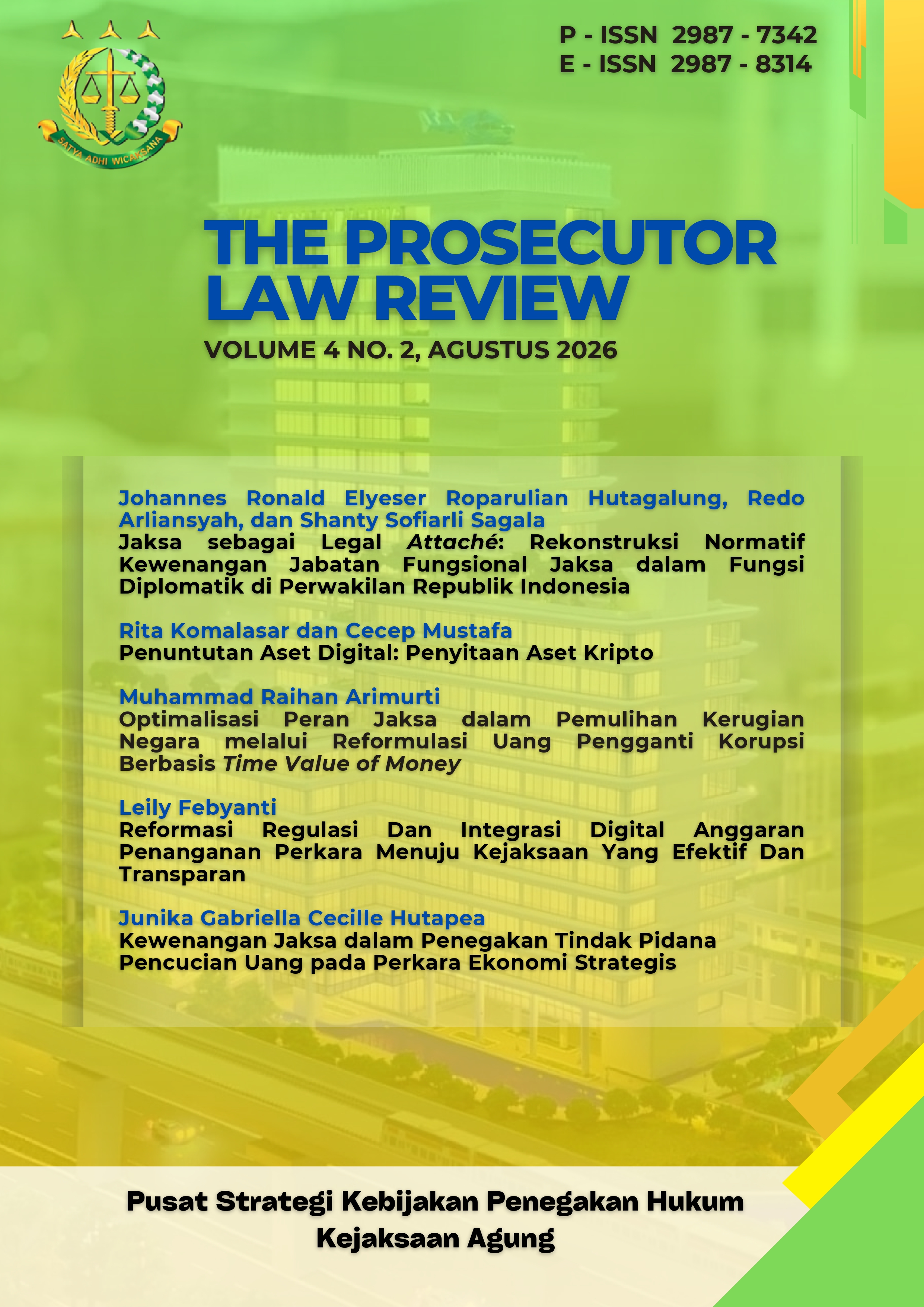
Prosecuting the Digital Frontier: Law Enforcement in Crypto Seizures
DOI:
https://doi.org/10.64843/prolev.v4i2.67Keywords:
Blockchain Analytics, Cryptocurrency Seizure, Digital Asset, ProsecutingAbstract
This study examines the role of cryptocurrency seizures in the prosecution of crypto-related crimes, focusing on the legal and procedural hurdles prosecutors face, as well as the broader implications for crime deterrence. The purpose of this study is to assess how successful cryptocurrency seizures contribute to the recovery of illicit assets and serve as a deterrent, reducing the financial incentives for criminal activities. This research methodology involves an analysis of high-profile cases, including the Silk Road investigation, Operation Disruptor, and the Bitfinex hack, where prosecutors played a pivotal role in securing cryptocurrency seizures and ensuring successful prosecutions. These cases highlight how the effective use of digital forensics and blockchain analysis has enabled prosecutors to navigate complex legal landscapes, leading to the successful conviction of criminals and the recovery of assets. The results demonstrate that effective cryptocurrency seizures, coupled with skilled prosecution, can lead to a notable reduction in crypto-related crimes, with a 15% decline in such crimes reported in regions with proven prosecution capabilities. Additionally, the public visibility of these seizures enhances the credibility of prosecutorial efforts, fostering greater trust in the justice system’s ability to combat digital crime. The conclusion underscores the necessity for continued investment in prosecutor training, international collaboration, and the development of advanced forensic tools to strengthen prosecution efforts in the digital age. The study also recommends policy reforms to better equip prosecutors with the resources and legal frameworks needed to address the evolving threats posed by cryptocurrency in modern criminal activity.
References
Bathily, Muhammad. "Reform of Senegalese Gendarmerie Intelligence Services." PhD diss., Monterey, CA; Naval Postgraduate School, 2018.
Brownworth, Anders, Jon Durfee, Michael Lee, and Antoine Martin. "Regulating decentralized systems: evidence from sanctions on Tornado Cash." (2024).https://doi.org/10.2139/ssrn.4930935
Ganne, Emmanuelle. Can Blockchain revolutionize international trade?. Geneva: World Trade Organization, 2018.
Georgoulias, Dimitrios, Jens Myrup Pedersen, Morten Falch, and Emmanouil Vasilomanolakis. "Botnet business models, takedown attempts, and the dark web market: A survey." ACM Computing Surveys 55, no. 11 (2023): 1-39.https://doi.org/10.1145/3575808
Gray, Glen L. "An Exploration of the Money Laundering Associated with the Bitfinex Bitcoin Hack." Journal of Emerging Technologies in Accounting 21, no. 1 (2024): 43-57.https://doi.org/10.2308/JETA-2023-017
Hämäläinen, Lasse. "User names of illegal drug vendors on a darknet cryptomarket." Onoma 50 (2019): 43-68.https://doi.org/10.34158/ONOMA.50/2015/2
Hiramoto, Naoki, and Yoichi Tsuchiya. "Measuring dark web marketplaces via Bitcoin transactions: From birth to independence." Forensic Science International: Digital Investigation 35 (2020): 301086.https://doi.org/10.1016/j.fsidi.2020.301086
Kapsis, Ilias. "Crypto-assets and criminality: A critical review focusing on money laundering and terrorism financing." Organised Crime, Financial Crime, and Criminal Justice (2023): 122-141.https://doi.org/10.4324/9781003020813-8
Kamensky, Dmitriy, Andrii Chernyak, Oleksandr Dudorov, Igor Fedun, and Serhii Klymenko. "Laundering of Criminal Proceeds Through Cryptocurrency Transactions: A Digital Threat to Economic Security." Law, State & Telecommunications Review/Revista de Direito, Estado e Telecomunicações 16, no. 2 (2024).https://doi.org/10.24144/2788-6018.2024.01.88
Kavaloski, Mary. "A Global Crypto Code of Conduct: Crafting and Internationally Centralized Regulatory Body for a Decentralized Asset." Vand. J. Transnat'l L. 57 (2024): 301.
Özen, Ercan, and N. Serap Vurur. "Digital era digital risks: the case study of Turkish crypto currencies market." In Creşterea economică în condiţiile globalizării, pp. 10-13. 2021.
Pardhey, Nanda, Yahya Hameed Issa, and P. C. Libeesh. "Regulatory Mechanism of Cryptocurrency Blockchain in Banking, Financial, and Capital Markets in the Indian Panorama." In The Impact of AI Innovation on Financial Sectors in the Era of Industry 5.0, pp. 96-107. IGI Global, 2023.https://doi.org/10.4018/979-8-3693-0082-4.ch006
Raeesi, Reza. "The silk road, bitcoins and the global prohibition regime on the international trade in illicit drugs: can this storm be weathered?." Glendon Journal of International Studies 8, no. 1-2 (2015).
Stan, Adrian. "The Challenges Of Extended Confiscation. Directive 2014/42/Eu And Transposing Difficulties In Romania." EU and comparative law issues and challenges series (ECLIC) 3 (2019): 637-658.https://doi.org/10.25234/eclic/9024
Zhang, Shuyu, Dunli Zhang, Jianming Zheng, Walter Aerts, and Dandan Xu. "Plus Token and investor searching behaviour-A cryptocurrency Ponzi scheme." Accounting & Finance 63, no. 4 (2023): 4713-4728.https://doi.org/10.1111/acfi.13128
Downloads
Published
How to Cite
Issue
Section
License
Copyright (c) 2026 Rita Komalasari, cecep mustafa

This work is licensed under a Creative Commons Attribution-NonCommercial-ShareAlike 4.0 International License.