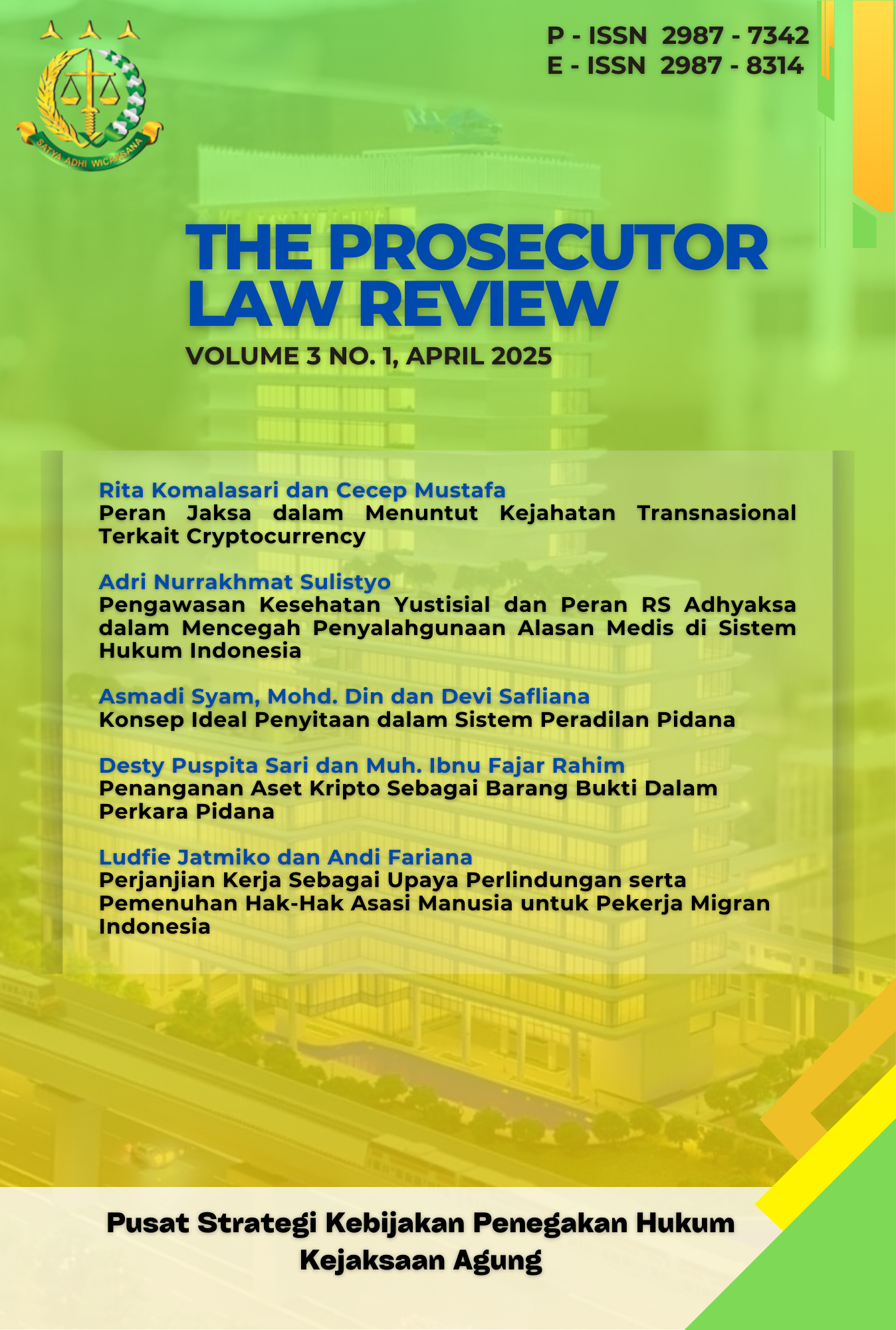
Prosecutor’s Role in Prosecuting Cryptocurrency-Related Transnational Crimes
DOI:
https://doi.org/10.64843/prolev.v3i1.48Keywords:
Cryptocurrency Assets, Informal Cooperation, Transnational Cases, International StakeholdersAbstract
This study, titled Prosecutor’s Role in Prosecuting Cryptocurrency-Related Transnational Crimes, aims to comprehensively analyze the crucial role of informal cooperation in addressing the challenges posed by cryptocurrency assets in transnational cases. It provides insights into how informal cooperation mechanisms among international stakeholders are vital for prosecutors in managing the complexities of cryptocurrency-related investigations. The study finds that informal cooperation is indispensable for prosecutors, offering strengths such as agility, flexibility, and effective information exchange. It also identifies weaknesses like information asymmetry and coordination issues. The analysis underscores the importance of enhancing collaborative relationships among international stakeholders and offers recommendations for improving informal cooperation mechanisms to better support prosecutorial efforts.
References
Arifin, Ridwan, Sigit Riyanto, and Akbar Kurnia Putra. "Collaborative efforts in ASEAN for global asset recovery frameworks to combat corruption in the digital era." Legality: Jurnal Ilmiah Hukum 31.2 (2023): 329-343. https://doi.org/10.22219/ljih.v31i2.29381
Barbereau, Tom, and Balázs Bodó. "Beyond financial regulation of crypto-asset wallet software: In search of secondary liability." Computer Law & Security Review 49 (2023): 105829. https://doi.org/10.1016/j.clsr.2023.105829
Collins, John. "Crypto, crime and control." Cryptocurrencies as an enabler of organized crime, Global Initiative Against Transnational Organized Crime (2022).
Delston, Ross S., and Stephen C. Walls. "Terrorist Exploitation Points in the International Financial System: Major Vulnerabilities in the Anti-Money Laundering and Countering the Financing of Terrorism Framework. Avenues for Transatlantic Cooperation." Terrorism and Transatlantic Relations: Threats and Challenges (2022): 191-222. https://doi.org/10.1007/978-3-030-83347-3_9
Gilmour, Paul Michael. "Decentralized blockchain technology: towards a trusted and transparent beneficial ownership regime." Financial Technology and the Law: Combating Financial Crime. Cham: Springer International Publishing, 2022. 185-209. https://doi.org/10.1007/978-3-030-88036-1_8
Golonka, Anna. "Cooperation with third countries in combating money laundering in the face of modern challenges." Ius Novum 17.4 (2023): 15-39. https://doi.org/10.2478/in-2023-0027
Healey, Jason, Neil Jenkins, and J. D. Work. "Defenders disrupting adversaries: framework, dataset, and case studies of disruptive counter-cyber operations." 2020 12th International Conference on Cyber Conflict (CyCon). Vol. 1300. IEEE, 2020. https://doi.org/10.23919/CyCon49761.2020.9131725
Ilbiz, Ethem, and Christian Kaunert. "Sharing Economy for Tackling Crypto-Laundering: The Europol Associated 'Global Conference on Criminal Finances and Cryptocurrencies'." Sustainability 14.11 (2022): 6618. https://doi.org/10.3390/su14116618
Laksono, Hazmi Tri, and Muhammad Fuadillah Nugraha. "Cryptocurrency Fever: Should Southeast Asian countries cooperate on facing cryptocurrency market." Proceedings of Airlangga Conference on International Relations (ACIR 2018) Politics, Economy, and Security in the Changing Indo-Pacific Region. 2021. https://doi.org/10.5220/0010276603240330
Lupianto, Ezzah Nariswari. "Asset Recovery for Victims of "Binary Option" Case in Review of International Criminal Law." Corruptio 3.1 (2022): 47-60. https://doi.org/10.25041/corruptio.v3i1.2640
Kshetri, Nir. "The nature and sources of international variation in formal institutions related to initial coin offerings: preliminary findings and a research agenda." Financial Innovation 9.1 (2023): 9. https://doi.org/10.1186/s40854-022-00405-x
Katsios, Stavros, and Ioannis Blatsos. "Cryptocurrencies' Asset Recovery: A Multi-Dimensional Approach." Cyber Laundering: International Policies and Practices. 2023. 281-310. https://doi.org/10.1142/9781800612839_0011
Kethineni, Sesha, and Ying Cao. "The rise in popularity of cryptocurrency and associated criminal activity." International Criminal Justice Review 30.3 (2020): 325-344. https://doi.org/10.1177/1057567719827051
Teichmann, Fabian Maximilian Johannes, and Marie-Christin Falker. "Cryptocurrencies and financial crime: solutions from Liechtenstein." Journal of Money Laundering Control 24.4 (2021): 775-788. https://doi.org/10.1108/JMLC-05-2020-0060
Reinsberg, Bernhard. "Fully-automated liberalism? Blockchain technology and international cooperation in an anarchic world." International Theory 13.2 (2021): 287-313. https://doi.org/10.1017/S1752971920000305
Sukumar, Arun, Dennis Broeders, and Monica Kello. "The pervasive informality of the international cybersecurity regime: Geopolitics, non-state actors and diplomacy." Contemporary Security Policy 45.1 (2024): 7-44. https://doi.org/10.1080/13523260.2023.2296739
Teichmann, Fabian Maximilian Johannes, and Marie-Christin Falker. "Cryptocurrencies and financial crime: solutions from Liechtenstein." Journal of Money Laundering Control 24.4 (2021): 775-788. https://doi.org/10.1108/JMLC-05-2020-0060
Vardalaki, Aikaterini, and Vasileios Vlachos. "Emerging malware threats: The case of ransomware." Cybersecurity Issues in Emerging Technologies. CRC Press, 2021. 153-170. https://doi.org/10.1201/9781003109952-9
Downloads
Published
How to Cite
Issue
Section
License
Copyright (c) 2025 Rita Komalasari

This work is licensed under a Creative Commons Attribution-NonCommercial-ShareAlike 4.0 International License.